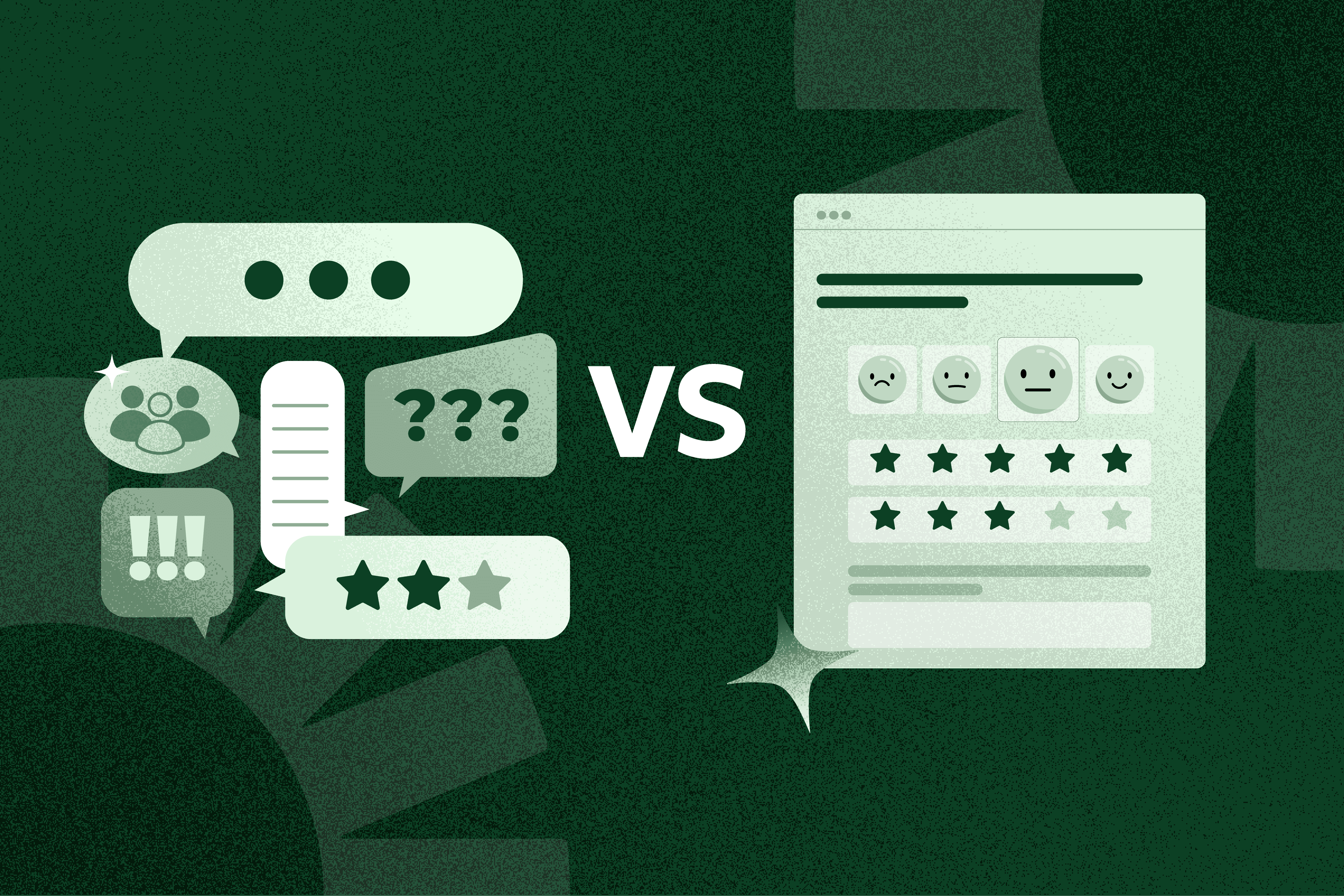
When you start decoding your audience’s behavior and what drives their decisions, you find yourself facing two completely contrasting scenes: a room where people gather with their faces, tones, and emotions, revealing the warmth of feelings and the intensity of reactions, and, on the other hand, a screen displaying silent but precise numbers, forming charts that tell trends impossible to ignore.
Between the warmth of conversation and the coldness of measurement, the question arises that puzzles any researcher: do you need to hear the words being spoken, or is counting the answers enough? Here lies the real difference between focus groups and digital surveys.
Although many organizations fall into the trap of making the wrong choice, understanding the differences between the two methods gives you the ability to select the right tool for each stage of development, whether you are launching a new product, improving the customer experience, or testing your marketing campaigns.
In this article, we will explore how each tool works, when to use it, and its advantages and disadvantages, along with a comprehensive table summarizing the differences clearly, enabling you to make a confident and precise decision.
First: What Are Focus Groups?
Focus groups are a qualitative research method that brings together 6 to 12 participants representing a specific segment of the target audience, with the aim of exploring their ideas, feelings, impressions, and motivations regarding a particular product, service, or concept. The session is led by a professional moderator who manages the discussion, asks questions, and guides the dialogue among participants in a way that reveals genuine attitudes and allows interaction between them.
Focus groups do not aim to reach a consensus or collective decision; rather, they seek to extract deep, exploratory insights into human behavior and actual experiences. This provides qualitative data that is difficult to obtain through quantitative tools such as surveys.
Focus groups can be conducted in person in a neutral environment that provides comfort and safety for participants, or remotely via video conferencing, which facilitates recruiting participants from multiple locations without the need for separate sessions.
This method is considered one of the most important market research techniques because it helps organizations to:
Understand the motivations behind customer behavior, not just measure it.
Test designs, advertisements, and new products before launch.
Discover perceptions that are not visible in digital data.
Craft effective marketing messages based on the reality of the audience.
In short: Focus groups are a research tool that reveals what customers think, why they think that way, and how the organization can develop its products and strategies based on real and practical insights.
Advantages of Focus Groups
Allow interaction among participants to reach in-depth insights, spark new ideas, and consider alternative perspectives.
Excellent for the initial exploration phase.
Help test ideas that require direct clarification.
Provide deep qualitative insights into participants’ thoughts, feelings, and experiences.
Capture subtle and contextual details that may be missed in quantitative surveys.
Offer diverse perspectives, as focus groups bring together participants from different backgrounds and segments for varied opinions.
Flexible, allowing the discussion to be adjusted and deepened based on participants’ responses.
Limitations of Focus Groups
Not suitable for large samples, and it is difficult to generalize results to a wider audience due to the limited sample size and potential selection bias.
Require significant resources, including time for organization and analysis, a skilled moderator, and a space for discussion, whether physical or virtual.
Results may be influenced by a dominant participant affecting others.
Analysis can be subjective, as interpreting participants’ responses depends on the researcher’s skills and biases.
Second: What Are Digital Surveys?
Digital surveys are online research tools designed to collect measurable quantitative data from a wide audience. They consist of a structured series of questions sent to participants with the aim of analyzing trends, evaluating experiences, and measuring levels of satisfaction, preferences, and behaviors. These surveys are distinguished by their ability to reach large segments quickly, while providing accurate results that can be relied upon for decision-making.
Digital surveys rely on two essential elements:
The Sample: This is the selected group of the target audience asked to respond. It may be a general segment or a very specific group, such as users of a particular service or regular customers of a product.
The Survey: This is the digital form composed of closed, open, or mixed questions, designed according to the research objectives.
Digital surveys are not limited to collecting responses; the resulting data can be analyzed using analytical tools and dashboards that reveal patterns and trends, making them ideal for quantitative research and data-driven decision-making.
Digital surveys are used for:
Measuring customer satisfaction and experiences.
Analyzing user behavior and trend propagation.
Monitoring changes over time through periodic studies.
Studying audience demographic characteristics.
Making decisions based on precise quantitative data.
In short: Digital surveys are an effective online research method for collecting and analyzing quantitative data from a wide audience. They are used to understand trends and preferences and to make informed, data-driven decisions rather than relying on guesswork.
Advantages of Digital Surveys
Fast to prepare, distribute, and analyze, with the ability to manage a large number of participants simultaneously.
Lower cost compared to traditional research methods.
Provide access to a wide and diverse audience in a short time.
Ensure participant confidentiality, which increases the honesty of responses.
Integratable with analytical tools and dashboards for effective monitoring of results.
Produce organized quantitative data that can be statistically analyzed to identify trends and patterns.
Standardize questions to ensure consistency and accuracy of data collection.
Limitations of Digital Surveys
Do not reveal deep reasons behind behavior or individual motivations and feelings.
Do not provide direct interaction among participants to clarify perspectives.
Some users may ignore participation if the survey is not engaging.
Require precise question wording to avoid bias and the influence of phrasing on responses.
Responses may be biased, especially on sensitive or controversial topics.
Participant fatigue: frequent surveys can reduce the quality of responses.
Read more: Discover the types of survey bias and how to avoid them for accurate results.
How to Collect Qualitative Data from a Digital Survey
A digital survey can be adapted to collect qualitative data through open-ended questions. These questions allow participants to express their opinions, feelings, and reasons for their choices in detail, providing a deeper understanding of the motivations behind their behavior. This way, you gain insights beyond the numbers while benefiting from the speed of reaching a wide audience and the measurement capabilities of digital tools.
Read more: What is the difference between closed and open-ended questions?
Differences Between Digital Surveys and Focus Groups
The table below highlights 15 key differences between digital surveys and focus groups, presented comprehensively and precisely to make it easier for you to compare and choose the most suitable tool for your research:
Property | Focus Groups | Digital Surveys |
Category | Qualitative (opinions, motivations, feelings) | Quantitative (numbers, percentages, ratings) |
Data Type | Small (usually 6–12 participants) | Large (hundreds to thousands) |
Sample Size | Small | Large |
Speed | Slow in terms of organization and analysis | Fast at all stages |
Researcher Role | Active and leads the discussion | Limited, focuses on question design |
Measurability | Limited | High and statistically analyzable |
Accuracy of Results | Depends on the facilitator’s skill | Depends on the quality of question design |
Bias | High potential for group influence | Lower, due to anonymity |
Flexibility | Requires participants to attend at specific times | Participants can answer at their convenience |
Analysis Method | Detailed linguistic and behavioral analysis | Statistical digital analyses with dashboards |
Question Types | Open-ended, encourages discussion | Closed-ended, ratings, multiple choice |
Repeatability | Difficult | Easy, can be conducted weekly or even daily |
Final Value | Understanding the human depth of behavior | Converts opinions into actionable indicators |
Non-verbal Data | Facial expressions, body language, and tone can be observed, enhancing understanding | Not available; relies only on written and sometimes audio responses |
Confidentiality & Privacy | Less confidential; participants interact face-to-face or via video | High; responses can be anonymous, encouraging honesty |
Focus Groups or Digital Surveys: Which Should You Choose?
Choosing between focus groups and digital surveys depends on four main factors: the type of data you need, the size of the audience you want to survey, your budget, and how quickly you need the data.
Choose focus groups if you:
Need to understand the reasons behind customer decisions.
Want to test a prototype of a product or design.
Want to know reactions that are difficult to measure numerically.
Are working on projects that require direct interaction, such as advertising content.
Want to explore participants’ perceptions, feelings, and experiences in depth.
Need to understand the reason behind specific quantitative data.
Can dedicate the time and resources required to organize interactive sessions.
Choose digital surveys if you:
Want to make quick decisions based on reliable data.
Are working with a large audience segment.
Need to measure customer satisfaction regularly.
Want to track changes over time (trend analysis).
Want results that can be presented to management via dashboards.
Want to collect data from a wide and diverse audience.
Want to measure trends, relationships, and patterns.
Have limited resources for conducting in-depth discussions.
How to Benefit from Both?
Relying on only one method to collect data is not enough. Combining digital surveys and focus groups gives you a comprehensive picture: while surveys provide precise, measurable quantitative data, focus groups reveal the reasons and motivations behind that data.
This approach allows you to reach a broad audience while gaining depth in understanding what participants think and why they think that way. The result is the ability to make clear, strategic decisions based on accurate data and qualitative insights simultaneously, making research more effective and reliable.
Read more: Why Your Company Needs Regular Surveys
9 Advantages of BSure That Make Your Research Faster and More Accurate
The BSure platform provides research solutions that help organizations rely on data without any complexity or extra cost. The platform allows you to:
1. Create Professional Surveys in Minutes
Design surveys using drag-and-drop functionality with no technical experience required.
Ready-made templates help you start your research quickly.
Read more: How BSure Shortens All Survey Stages in One Place
2. Customize Survey Appearance
Modify the look, fonts, and colors to match your brand identity.
Use skip logic, dynamic questions, and question ordering to tailor the survey to your objectives.
Read more: How to Design Your Survey Identity in BSure
Receive direct voice responses from participants for natural impressions and authentic expression.
Ideal for understanding tone and emotions behind answers, especially for open-ended questions.
4. Smart Publishing Across All Channels
Publish surveys via email, SMS, social media, websites, or QR codes.
Reach your audience at the time and place you choose with no extra effort.
5. Advanced Analytics
Key performance indicators (KPIs).
Measure customer satisfaction and NPS.
Instant and visual analytics to accelerate decision-making.
6. Support for Focus Group Results
Focus group insights can be used to create precise surveys targeting larger segments, ensuring your decisions are based on both qualitative and quantitative data.
Display all results in one clear, visual location.
Combine survey data with focus group results for a comprehensive view.
8. Flexible Access and Reporting
Export data in various formats (Excel, CSV, PDF).
Share results easily with your team or management.
9. Performance Monitoring and Periodic Reporting
Track customer satisfaction trends and long-term changes.
Identify trends and patterns with ease.
Conclusion:
No tool is inherently better than the other; the choice depends on your goal and the stage of your project. Focus groups open the door to understanding human depth, while digital surveys give you the space to see the bigger picture. Combining these two approaches not only merges two types of data but provides a balanced research methodology that delivers comprehensive knowledge you can confidently act upon.
Ready to Get Started?
Start Now with BSure. Create your first survey in minutes, gain deep insights into your audience, and make strategic decisions based on real, actionable insights.